Join Me For a Great Cause


Hi There! I know it has been a while since my last blog. I have been dealing with some personal issues, but I am back with share with you something that is very important for me. As you know it is officially spring, though I woke up to below freezing temperature this morning, I still feel spring in the air. Why not take advantage of it. Especially, if you leave near the Washington D.C. metro area imagine the Tidal Basin filled with the beautiful blooming cherry blossom. What a breathtaking view!

Now let spring inspire us to take a healthy step and mark your calendar for the Annual Congenital Heart Walk in Wheaton Maryland. This year again it is taking place at the beautiful Wheaton Regional Park located at 2000 Shorefield Road, Wheaton, MD (just off the Beltway) on Saturday, April 25th at 9:00 a.m. The walk is for a wonderful cause. The Congenital Heart Walk is a national fundraising event series benefiting the Adult Congenital Heart Association (ACHA) and The Children’s Heart Foundation (CHF). We walk to honor and remember the millions who have been impacted by congenital heart disease (CHD). CHD  is the most common birth defect effecting approximately 8 in every 1000 babies born each year. As a research personnel, working at the Heart Institute of Children’s National Health System, I have seen babies and children who are born with complex heart disease who are rushed to the hospital for open heart surgery when they are just a hour or so old. I have friend who have been impacted by the defect and I am joining the walk to for my friends and everyone I serve and had the privilege of knowing with the condition who are know longer among us.

Hence, please joins us to support such an important cause. If you cannot join us in person please support us in spirit by donating to the link. Thank you for being part of this wonderful cause.

http://events.congenitalheartwalk.org/site/TR/Walk/General?px=1047333&pg=personal&fr_id=1170
Beginner Ab Workout


During the holidays, we all crave sweets and then comes the regret part. I for one loose my motivation for ab workout due to strain in my back and neck due to crunches. Today, I will share beginner crunchless ab workout with you from Fitness Blender which is easy to and do and is easy on your back and neck. The exercises require little space and no equipments. Hope you enjoy it. Happy Reading.

Workout Details:

This crunch free abs routine is a great combination of light cardio and core toning moves that won’t have your neck or back aching. It’s a great place for beginners to start.

None of these exercises require any equipment at all, and they require minimal space, making this a workout that you could easily do in a hotel room, dorm room, or office.

There are nine different standing abs exercises in this routine. We are going to be doing each for a total of 50 seconds, for a routine that comes in at just around ten minutes total. There is a very short rest period in between each move (roughly 10 seconds).

The exercises in this routine are low impact enough that you don’t really need a warm up before you start this video. In fact, this Standing Abs Workout could serve as light warm up cardio to get your body ready for a more difficult routine.

Crunch Free Abs Exercises – 50 Seconds of each
Double Chop Knee Pulls – Starting with both arms overhead, pull down and across the body, twice, before resetting & repeating on the opposite side. This one is for the abdominals, obliques, hip flexors, shoulders and quads.

Torso Twist Jabs – Go into a shallow squat, and twist at the torso to push each fist out diagonally across your body. Maintain the bend in your knees during the entire interval, going deeper if you want to make it more challenging. Glutes, hamstrings, quads, obliques, chest, rhomboid & biceps are the focus of this one.

Standing Toe Touches – Just like it sounds; keep a straight back and lift one leg straight out in front of your body, bringing the opposite hand down to touch that toe. Lower the leg, bring the arm back up above your head, and then repeat with the opposite limbs. Make sure that you don’t use any jerking motions or momentum to get any additional range of motion out of the kick; it is okay if you can’t get your leg very high. You will feel this in your abs, obliques, hip flexors, and quads.

Four Twist Knee Ups – Four torso rotations with a diagonal knee up on the fifth twist, maintaining a shallow knee bend the entire time. Think of it in this rhythm; twist, twist, twist, twist, knee up. This is an awesome obliques exercise. Hip flexors and thighs also have to pitch in.

Crossover Toe Touches – Extend arms straight out from your shoulders, and in a smooth & controlled motion, twist at the torso & bend to touch the toes of the opposite foot. Come back up, and repeat on the opposite side. The target of this standing abs exercise is your lower back, abdominals, and obliques.

Side Squat + Knee + Side Squat – With hands behind your head, squat to one side. When you push up from that squat, bring one knee up to the opposite elbow, before dropping back into a side squat, and then repeating the entire sequence on the entire side. Glutes, thighs, obliques, hip flexors and abs are the used during this motion.

Slow-Mo Rotations – Extend arms straight out from shoulders, slowly and deliberately twisting at the torso as far as is possible in each direction. The more focus you put into the rotations, the better it targets your obliques.

Tap Jacks – In a movement similar to a slow motion jumping jack, step side to side while tapping one foot behind you. Really focus on deliberate motions & you will feel this in your core and especially obliques.

Side Bends – Extend your arms straight out and slowly bend from side to side. You will feel this especially in your obliques.

How many calories does this Fitness Blender routine burn?
We estimate that this 10 minute workout video burns between 5-7 calories a minute, or 50-70 total.

Hope you enjoy doing this easy workout that address your core and is a great combination of light cardio and core toning moves. Happy Holidays.

Antipsychotic Medication Overuse In Nursing Homes


The past couple of mornings, I have been hearing the same story in NPR that has really alarmed me since my grandfather once has spend some time in nursing homes. If you have loved ones in nursing homes you need to pay attention. According to the NPR news, over 300,000 nursing home residents are wrongfully getting antipsychotic medication for Alzheimer or other forms dementia for which these drugs can be deadly. The Food and Drug Administration has black box warning for this drugs saying that they can increase the risk of heart failure, infections and death.

In 2012 the federal government started a program to get nursing homes to stop using such drugs. Nevertheless, nursing homes rarely get penalized for not complying with the program. My grandfather spend some time in nursing homes after losing his leg to gangrene and we brought him home after several incidents with nursing home abuse and I cannot imagine someone else’s loved ones going through this.  Remember FDA did not approve the drugs to treat dementia. Nursing home residents should only receive antipsychotic drugs only medically necessary.

Our current federal law prohibits the use such drugs for staff convenience, known as “chemical restraints”. These drugs can abruptly change behavior, can cause sedation, and increase the risk of fall. This is a public health concern and we need to adequate action. If you have a loved one in nursing homes make sure if he staff tells you that the doctor prescribed a medication and asks you to sign a form, ask questions and don’t sign until you are sure of what medication the doctor described and what it is for. Remember, getting informed consent when prescribing antipsychotic drug is required by law. As a public health person I found this topic quite important and hence wanted to bring it to you attention. If you have faced any issues with nursing homes with your loved ones please don’t forget to comment. Happy reading.

Newborn Heart Defect Screening


414258_228411283941772_826874988_o

Today, I want to write about something that is very close to my heart. As a research personnel, working at the Heart Institute of Children’s National Health System, I have seen babies and children who are born with complex heart disease who are rushed to the hospital for open heart surgery when they are just a hour or so old. Hence, I want to bring this important topic to your attention .  I have been advocating for this topic for a while. You can find more information on my facebook page.

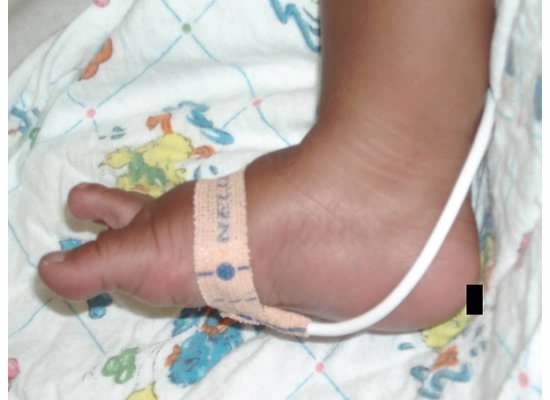
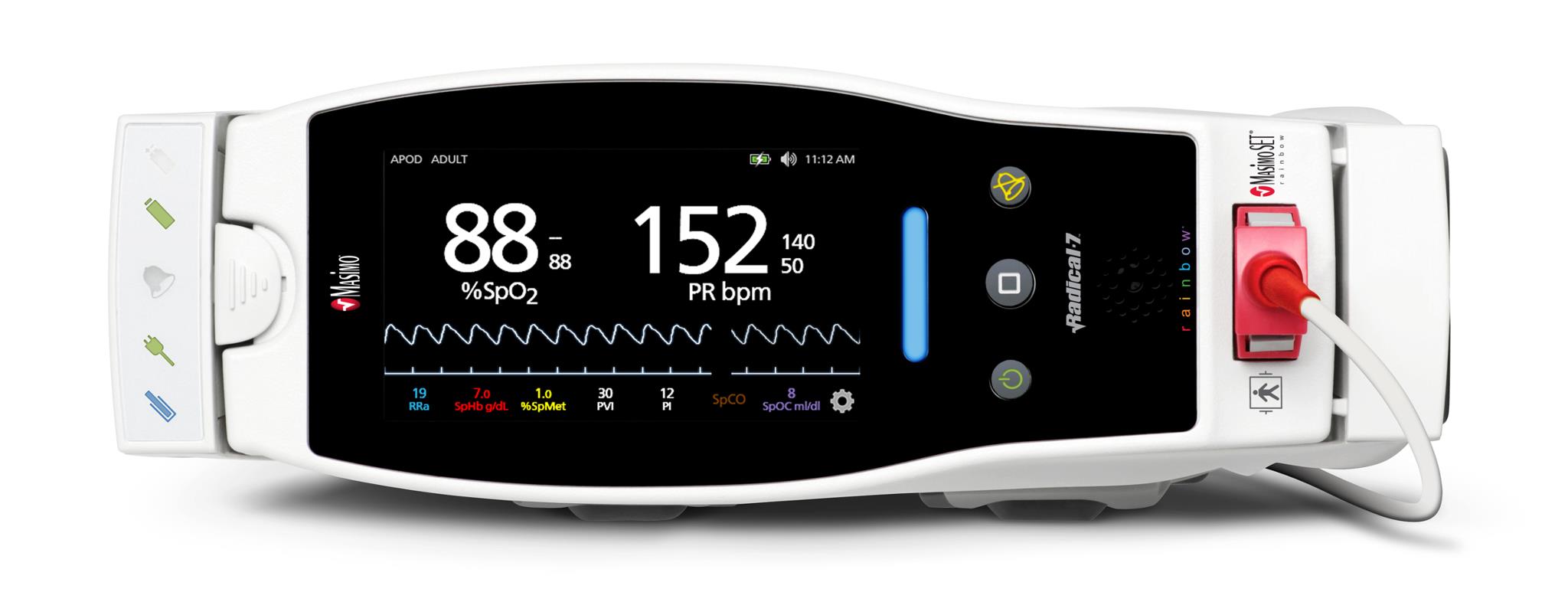
Congenital heart disease (CHD) is the most common birth defect effecting approximately 8 in every 1000 babies born each year. Patients with Critical Congenital Heart Disease or  CCHD, the most severe of form of this birth defect, require intervention before one year of age. Additionally, CCHD accounts for nearly 40% of deaths in children with congenital abnormality within the first year of life. Hence, if not detected early, critical congenital heart disease can cause severe problems and even death, with one study showing that 43% of babies diagnosed after hospital discharge from the nursery were in shock at the time of hospital readmission. Hence, the cost of missed diagnosis is enormous. Pulse oximetry, a simple, pain-free test that measure oxygen in the blood, has been recommended as a potential method for detection of critical congenital heart disease.

ry%3D400

Adding CCHD screening, using pulse oximetry, to the usual physical exam would lead to early detection of critical congenital heart disease in newborns and save countless lives.  Studies have shown that pulse oximetry has high rate of detection for critical congenital heart disease in newborn. Last year, a group of experts, both nationally and internationally, met in Washington, D.C. to discuss recommendation for best-practice for screening protocols and implementation and published strategies to implement newborn CCHD screening.

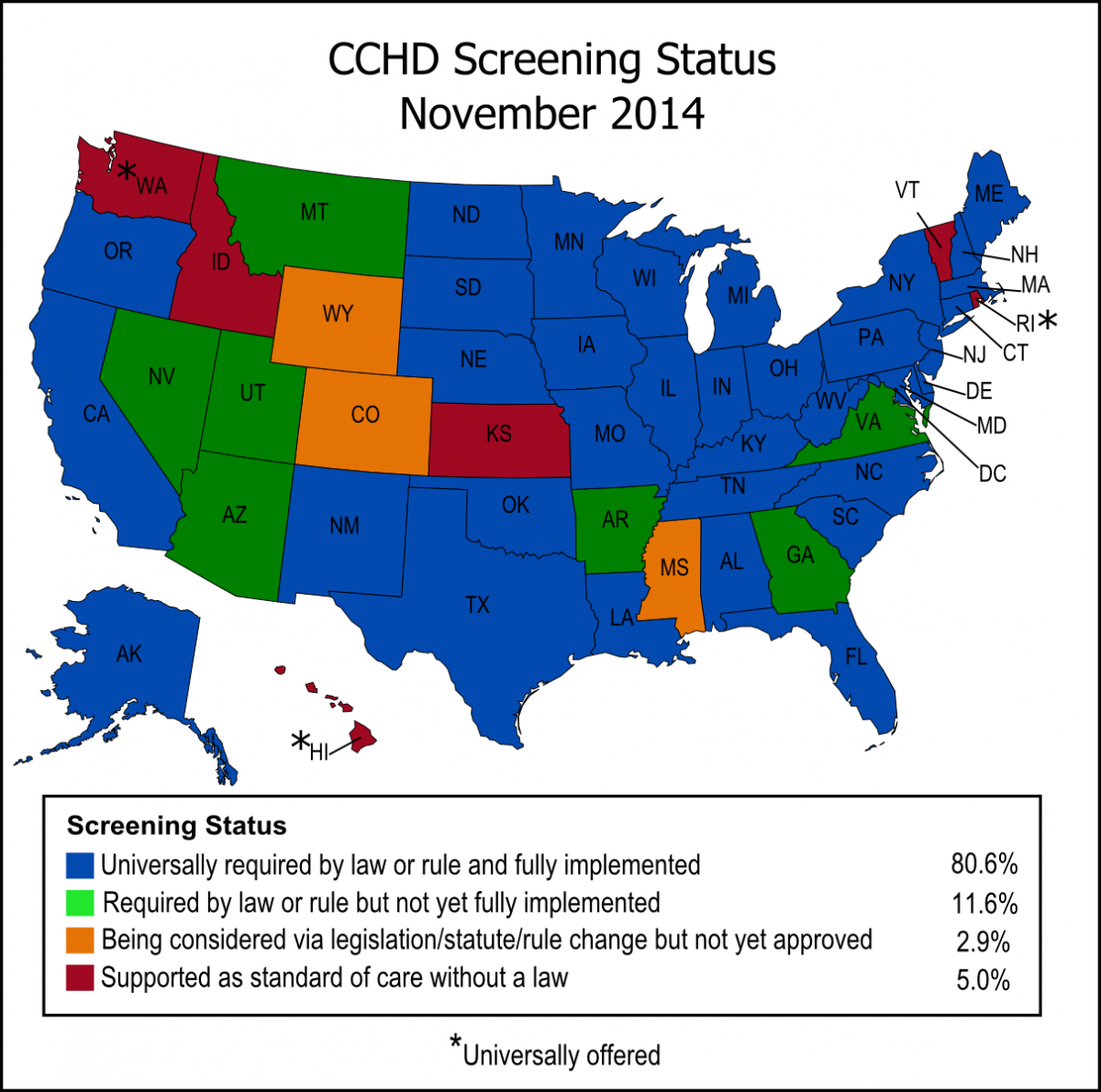
CCHD Map 11-3-14
Courtesy of NewSTEPS https://www.newsteps.org/cchd

In August 2011, New Jersey became the first US state to implement state-wide screening of newborns for CCHD, followed by Indiana. Additionally, Maryland, Tennessee, West Virginia, Connecticut, and New Hampshire passed legislation for state-wide implementation of CCHD screening using pulse oximetry. Now, many of the stated are universally required by law to screen newborns for CCHD prior to discharge. However, we have still more to go. Concerns were expressed over false-positive results leading to unneeded stress for families with added extra costs of unnecessary evaluation and transfers, on top of additional staff time. However, in a study done by Bradshaw and Colleagues of Children’s National Health System and Holy Cross Hospital, which was published in 2012 in the Journal of Perinatology, showed that pulse oximetry can be implemented successfully in community hospitals without excessive number of false-positive or added staff time. Additionally, a study by Ewer and Colleagues, published in 2011 in the medical journal of Lancet, found false-positive rate of 0.8% among more than 20,000 infants screened, of which 6 had significant congenital heart disease and 40 had other illness requiring urgent medical intervention. Furthermore, a British study looking at 13 studies with data from about 230,000 newborns, published online in Lancet, showed that pulse oximetry had a high rate of detection rate for critical congenital heart defects, with a false-positive rate of 0.14%. The false-positive rate was even lower (0.05%) when newborn pulse oximetry was done after 24 hours from birth. Another British study, first published online on May, 2012  on British Medical Journal looking at acceptance rate of CCHD screening among mothers, showed that CCHD screening was acceptable to mothers and false-positive results did not increase stress.

Hence, why are we gambling with the lives of our children? Studies have shown that the test costs from less than $5 to $10 to perform and could save countless lives. The benefits of improving newborns’ quality of lives outweigh any costs. Moreover, the cost of late detection is enormous. Though children are only quarter of our population, they represent 100% of our future and we should not gamble with our future. Newborn CCHD screening should become a practice standard across US. There are still takes who have not approved any laws requiring CCHD screening. It does not cost must but the impact is enormous. Please urge your lawmakers to take action. The time to take action is now!

Mindfulness Based Stress Reduction


buddha-in-the-moment

Stress…what do we mean when to talk about stress?How do we describe stress. It’s our body’s fight or flight response. National Institution of Mental Health (NIMH) defines stress as the following:

“Stress can be defined as the brain’s response to any demand. Many things can trigger this response, including change. Changes can be positive or negative, as well as real or perceived. They may be recurring, short-term, or long-term and may include things like commuting to and from school or work every day, traveling for a yearly vacation, or moving to another home. Changes can be mild and relatively harmless, such as winning a race, watching a scary movie, or riding a rollercoaster. Some changes are major, such as marriage or divorce, serious illness, or a car accident. Other changes are extreme, such as exposure to violence, and can lead to traumatic stress reactions.”

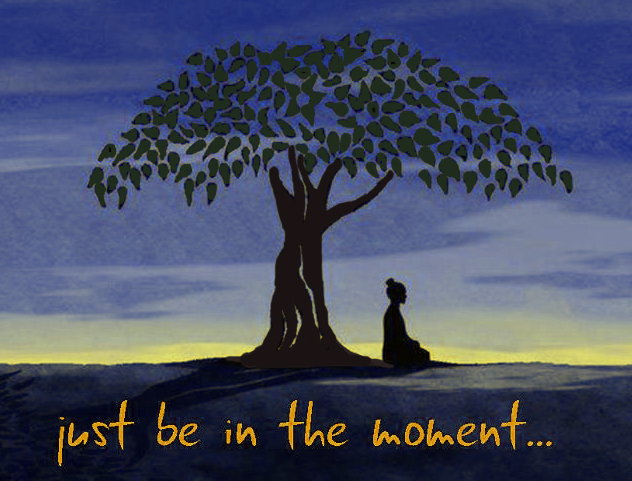
Nevertheless, our exposure to stress might be it can have a big toll on our health, hence my today’s blog. I, like many of us have dealt with stress to the point that I always had palpitation, high heart rate (higher than my usual benign high heart rate), insomnia, and anxiety. However, all that changed when I decided to take the 8 week Mindful Based Stress Reduction class Dr. Gina L Sager. She is a retired board-certified general surgeon, named one of Baltimore’s Top Docs in October 2000. Gina taught us to be aware of the present and be in the moment. I am currently in the 7th week of the class and I have so much difference in the class. You can talk her class in Town for $500 or simply her CDs 10% of the proceed of which will go to HopeWell Cancer Support.  I use her Yoga Nidra, a deed relaxing guided meditation CD every night help me fall asleep along with Melatonin. I have to say that has been a lifesaver for me. I also use her guided Sitting meditation CD during my one hour subway commute to work everyday that help feel focused and ready to take on the day with all my attention even with my ADD personality.

 20141103_083407

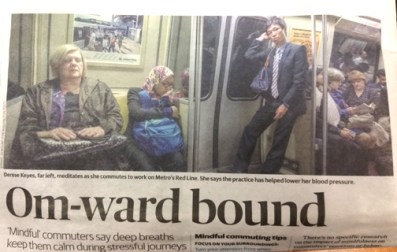
During one my long morning commute to work, a lady tapped my shoulder while I was on my meditation mode, and gave a local Washington Post Express newspaper pointing to a particular newspaper article, and saying “this is you”. What was interesting was that she observed it right. The lady in far left was like me. This is what I do everyday. So I am not alone. The article provided the following mindful commuting tips: 1) Focus on your surroundings: Focus you attention from when you will get to you destination to what you notice via your senses, like the sounds, the feel of you feet touching the ground, or places of your body that feel tense. 2) Focus on your breath: If you’re not riding a bike or driving take five slow, deep breaths, then return to normal breathing but try to notice each breath and the space between breaths. 3) Refuse your thoughts: you red lights or stops on a train or bus as a reminder notice whether you’re lost in though. Then refocus on your breathing or your senses.

There are some great free apps with guided meditation. The one that I love that most is Calm. It’s free in both Google Play and Itunes. This app can help you meditate, sleep, relax, focus and much more.  Don’t let stress take over your health and life. Let’s start by focusing on the moment and being aware of the present. However, in on order to conquer stress to we have to be aware of our feeling.

Next time I will focus on how pleasant and unpleasant feeling of stress. Until next time, I leave you with the following quotes from Jerry Spinelli,

“Live Yesterday.
Not Yesterday.
Not tomorrow.
Just today. 
Inhabit your moments.
Don’t rent them out to tomorrow.”